

In This Article
Narcissistic Friendship is one of the most draining forms of emotional attachment. It looks warm in the beginning, but slowly turns into a space where one person gives, absorbs, adjusts, and carries the entire weight of the bond. Many people stay trapped in a Narcissistic Friendship because the early affection feels genuine, the connection feels rare, and the good memories keep them hopeful. But over time, emotional imbalance, manipulation, mood swings, and silent withdrawal start damaging the person who cares the most. This kind of toxic friendship blurs the line between loyalty and self-neglect. It makes you question your worth, your intentions, and your reality. And by the time you recognise the pattern, you’re already exhausted.
This article shows how a Narcissistic Friendship forms, how it breaks you from the inside, and how choosing yourself becomes the only way to breathe again.
A Narcissistic Friendship doesn’t show its cracks in the beginning. It grows slowly. It builds warmth, comfort, and connection before the imbalance starts to appear. And when you’re emotionally invested, stepping back becomes harder. What follows is the exact story of how a simple connection turned into years of emotional fatigue for someone who gave more than she received.
When Alice Met Harry! A Story of Narcissistic Friendship
“Do not love a person, love the smile of that person—and then you will do everything to keep that smile alive. In that way, you love, respect, and value that person for the rest of your life.”
How It Began
This is the story of two unlikely friends—Alice and Harry—two people from different worlds, professions, and mindsets. They met by chance at a gym when Harry asked Alice for the address of a card shop. That simple interaction grew into a bond that eventually became a friendship, and then something deeper—best friends, companions, and emotional support.
They shared secrets, laughed together, spent hours talking after workouts, and stood by each other through difficult days.
For Alice, life felt magical.
For Harry, life felt lighter and happier with Alice in it.
Two Years of Friendship
After two years, Harry got married and left the gym. Yet he promised nothing would change between them.
“You will always remain my priority, Alice.”
And for a long time, nothing did.
He remained caring, thoughtful, and respectful.
Their families knew they were inseparable.
The Shift
But two more years later, the Harry Alice knew began to disappear.
He became angry, irritable, negative—and sometimes abusive.
Whenever Alice tried to express hurt, he turned it around:
“You’re dramatic. You want attention. You find faults in me. You make me feel guilty.”
Alice knew this wasn’t the real Harry. She could see his frustration—marital issues, family pressure, financial stress, and insecurity.
In good moments, he admitted it wasn’t her fault.
But inconsistency became emotional torture.
The Narcissistic Pattern?
Gradually, Alice began noticing traits she once ignored:
• Inflated ego
• Fragile self-esteem
• Controlling behaviour
• Lack of empathy
• Tit-for-tat attitude
Harry believed everyone criticized him.
He felt like the only one who sacrificed, the only one who suffered, forgetting how much Alice did for him.
He stopped celebrating her happiness.
Every conversation became about his pain, his stress, his life.
There was no space left for Alice.
Growing Distance
Alice tried to help—counselling, calm conversations, emotional support.
For a short time, his temper improved, but criticism continued to be his trigger.
Even gentle suggestions felt like attacks.
He stopped sharing his life with her.
He believed she belittled him.
He chose to remain in silent zone after arguments and used his silence and withdrawal as a tool to control Alice
Arguments turned into battles she could never win.
So, Alice went silent—and silence suffocated her.
He sensed her withdrawal but never asked why.
His ego couldn’t handle the answer.
Two Opposite Worlds
Alice was mature, compassionate, balanced, and empathetic.
Harry was unhealed, defensive, insecure, and stubborn—fighting his demons while pushing away the one person who stood by him.
Inside him was a constant battle: the good version of Harry vs the ego version.
Inside Alice was confusion:
Which Harry was real?
A Hard Truth
You cannot keep hurting someone and expect them to stay the same.
Every person has a breaking point.
Once crossed, nothing returns to what it was.
Harry expected Alice to always understand him, but he rarely tried to understand her.
A relationship where only one person apologizes, adjusts, sacrifices, and absorbs the damage cannot survive.
Alice’s Seven-Year Battle
Alice stayed for almost seven years after things changed.
She tried to communicate, heal him, and stand by him through his storms.
But the more she tried, the more he manipulated, controlled, and twisted situations.
His ego grew taller.
His mind games grew sharper.
His mood swings became unpredictable.
She realized something painful but important:
You cannot win with a narcissist.
Because a narcissist is not trying to resolve—they are trying to win.
Choosing Self-Respect
Alice finally chose herself—not out of anger, but out of survival.
She did not leave to punish Harry.
She left because staying was destroying her.
Self-respect is not about giving up on someone.
It is about not giving up on yourself.
She didn’t leave because she stopped caring—
She left because she began to care about herself.
And that was her victory.
The Reality of Narcissistic Love
Harry was not entirely insensitive.
He cared in the way he was capable of caring.
He relied on Alice for comfort, security, validation, and emotional support.
But needing someone is not the same as loving them.
A narcissist enjoys being understood,
but rarely tries to understand.
Alice forgave more than she should have,
accepted his mood swings, more than she deserved.
Even the strongest heart has limits.
Final Message
Sometimes the hardest goodbyes are the ones given while love still exists.
Alice didn’t walk away because she stopped caring.
She walked away because love should not feel like emotional survival.
Harry may never realize what he lost, because narcissists don’t lose people—they lose sources of validation.
Alice gave loyalty, patience, kindness, and time.
And when it began to destroy her from the inside,
She saved herself.
This is not the story of a woman who left—it is the story of a woman who returned to herself.
Because in the end:
• Self-respect is louder than an apology
• Silence is stronger than arguments
• Walking away is braver than holding on
• Choosing yourself is the most powerful love of all
Alice didn’t lose Harry.
She freed herself.
And sometimes, freedom is real happiness!
Also Read: Happiness is a choice. Choose to be happy!
What Is a Narcissistic Friendship?
A Narcissistic Friendship usually includes:
• Inflated ego and self-image that hides insecurity
• One-sided emotional labour
• Lack of empathy for the other person
• Unpredictable mood swings
• Silent withdrawal to gain control
• Tit-for-tat reactions
• Blame shifting
• Emotional manipulation
People caught in this dynamic often stay longer due to good memories, a strong attachment, and the hope that things will return to the early phase.
But with a narcissistic pattern, the cycle rarely breaks.
Early phases of a Narcissistic Friendship often feel intense and comforting because the other person gives extra attention, warmth, and emotional closeness. This phase is linked to a behaviour called love bombing, where affection and effort come in high doses at the start and slowly fade once control develops. Understanding this early boost helps you see why people get attached so deeply before the toxic cycle begins.
For a deeper understanding of narcissistic traits and behaviour, you can explore this resource by Psychology Today: Narcissism.
Why People Stay in Toxic Friendships?
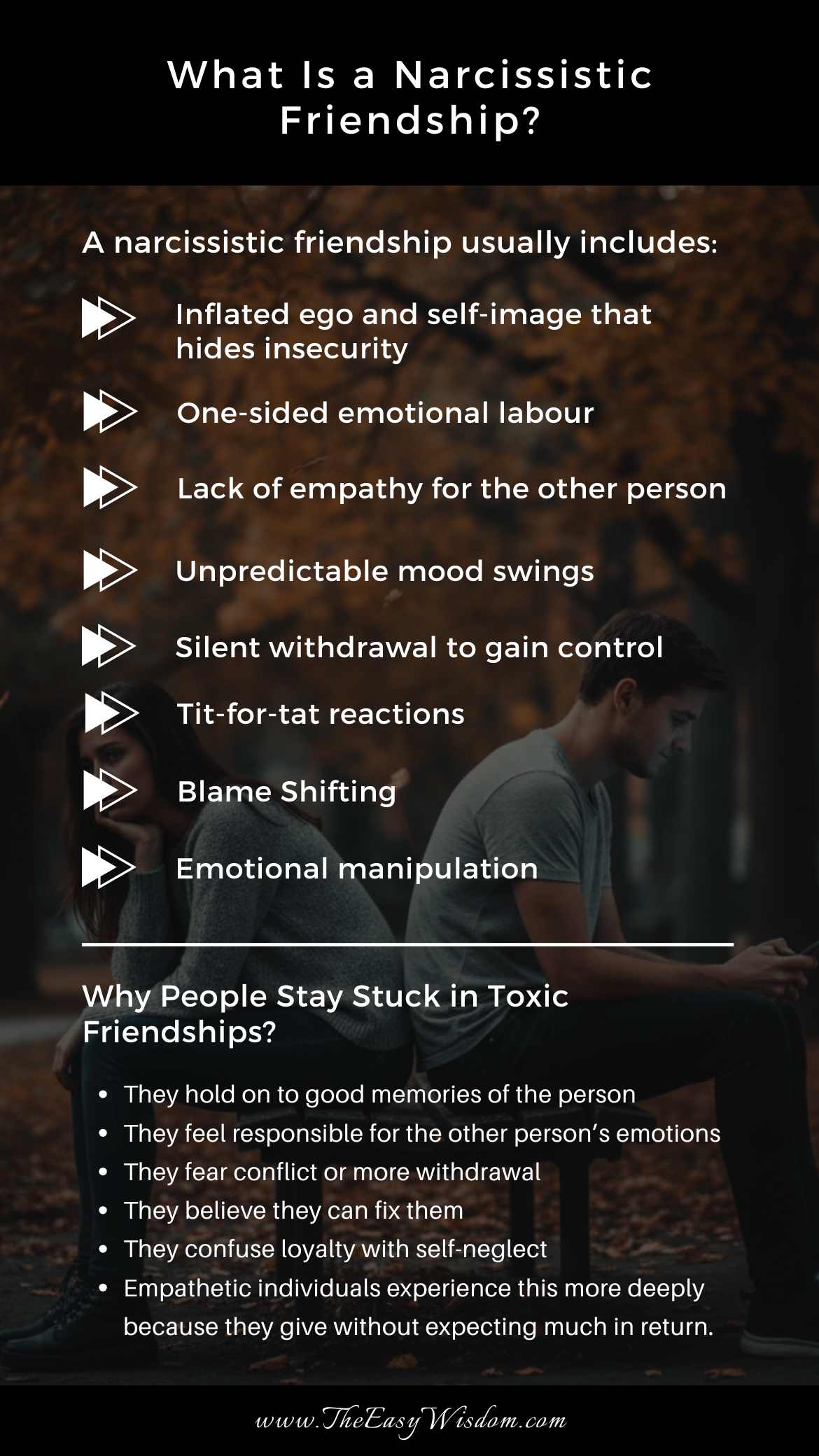
People remain stuck in a Narcissistic Friendship because:
• They hold on to good memories of the person
• They feel responsible for the other person’s emotions
• They fear conflict or further withdrawal
• They believe they can fix them
• They confuse loyalty with self-neglect
Empathetic individuals experience this more deeply because they give without expecting much in return.
If you ever wondered what triggers raise red flags in relationships and friendships, you might find this helpful: a resource titled “Signs You Are Dating a Narcissist” outlines common indicators of emotional manipulation, such as constant need for admiration, lack of empathy, frequent gaslighting, and one-sided emotional demand. These traits often carry over into friendships too — turning what seems like support into a draining cycle of emotional exhaustion and control.
Key Learnings From This Narcissistic Friendship
• A one-sided friendship drains your emotional strength
• Silent treatment is a control tactic
• Love cannot fix someone who chooses ego
• Emotional manipulation becomes normalised slowly
• Walking away is sometimes the only healthy choice
Narcissistic friendships leave lasting emotional scars, but they also teach the most powerful lesson—you matter too.
Your peace matters.
Your voice matters.
Your emotional safety matters.
Choosing yourself is a strength, not abandonment.
Choose yourself and learn to say no!