


Have you ever felt the heavy, thumping bass in your chest at a live concert? Or maybe you have experienced full-body goosebumps when a specific, powerful song plays? Sound has a profound, undeniable physical presence. Yet, when we are exhausted and put on a playlist of “relaxing music” at the end of the day, it often isn’t enough to melt away the deep tension in our shoulders or quiet a stubbornly racing mind.
While listening to calming audio is a great start, traditional listening only involves sound waves interacting with your eardrums. If your nervous system is trapped in a state of chronic stress, merely hearing a gentle melody won’t automatically release the physical knots in your muscles. To truly reset your body and mind, you need a way to absorb that calm physically.
You Are an Acoustic Resonator
To understand why physical sound is so powerful, we have to look at a few fascinating facts about physics and human biology.
Consider this: sound travels roughly 4.3 times faster through water than it does through air. Because the average adult body is comprised of about 60% water, you are essentially a walking, breathing acoustic resonator. Your body is biologically primed to conduct vibration.
Ancient cultures understood this intuitively long before modern science could measure it. For thousands of years, humans have used physical sound waves as a form of medicine:
- Aboriginal Didgeridoos: For over 40,000 years, Aboriginal Australians have used the deep, resonant vibrations of the didgeridoo to clear energy and, remarkably, to help heal muscle tears and broken bones.
- The Healing Purr: It isn’t just humans. Domestic cats purr at a frequency between 25 and 140 Hertz (Hz). Veterinary researchers have found that these specific frequencies actively promote tissue regeneration, reduce swelling, and even repair bone density.
When you put on headphones to listen to ambient music, you are missing out on the physical, tissue-level healing that low-frequency sound vibrations provide.
The Science of the “Ahhh” Moment
When you are exposed to these low-frequency sound waves, those therapeutic vibrations ripple through your internal water exactly like a stone dropped into a perfectly still pond. This creates a literal “cellular massage.”
This feeling of profound relief is deeply rooted in your neurobiology. According to clinical insights on neuromodulation featured in the National Library of Medicine, targeted low-frequency vibrations can actively stimulate the vagus nerve.
Wellness Fact: The vagus nerve acts as the primary “brake pedal” for your nervous system. Stimulating it directly and immediately shifts your body out of the anxious, cortisol-heavy “fight-or-flight” state and into a restorative “rest-and-digest” mode.
The Modern Solution: Vibroacoustic Therapy
So, how do we harness the bone-healing power of a cat’s purr and the deep cellular massage of ancient sound healing in our modern, busy lives?
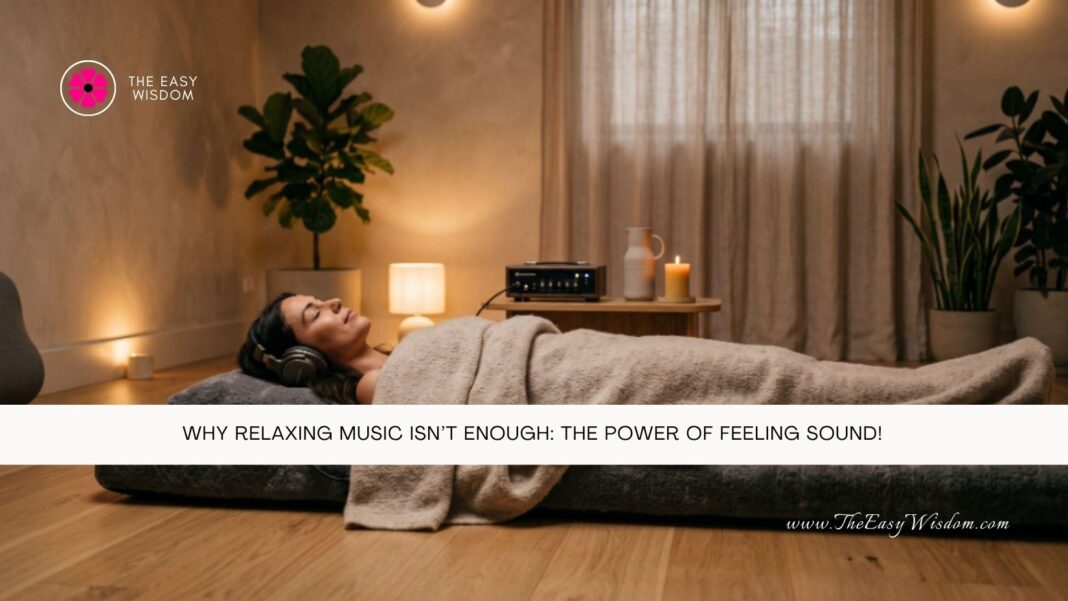
This is where advanced holistic technology bridges the gap through an evidence-based treatment known as vibroacoustic therapy (VAT). Instead of just playing music through speakers in a room, VAT utilizes specialized beds, mats, or chairs embedded with advanced transducers. These devices convert therapeutic sound frequencies into tangible, low-frequency vibrations that are driven directly into the body.
What the experience actually feels like:
- You simply lie back on a specialized, incredibly comfortable mat. It requires absolutely zero effort or meditation experience.
- Within minutes, you feel a wave of gentle warmth and soft tingling.
- The music doesn’t just play in the room; it resonates completely through your core, melting away joint stiffness and deep-seated muscle tension in a way traditional hands-on massage sometimes cannot reach.
If you are tired of trying to force your brain to power down at the end of a long week, it might be time to let your body lead the way. True calm requires engaging both the mind and the physical body.
Conclusion: Tuning Your Body for Deep Relaxation
At the end of the day, true relaxation shouldn’t feel like another task on your to-do list. While putting on your favorite calming playlist is a wonderful way to signal to your brain that it is time to unwind, true rest requires your physical body to get the message, too. By understanding your body as a resonator, capable of absorbing the deep, healing frequencies that melt away tension and regulate your nervous system, you open the door to a completely new level of recovery.
You don’t have to force your way into a meditative state or battle through chronic physical tension alone. If you are ready to transition from a chaotic “fight-or-flight” state into true, cellular-level restoration, exploring innovative modalities like vibroacoustic therapy might be the missing piece in your wellness routine. Stop just listening to the calm, and start allowing your body to finally feel it.